Vocabulary study
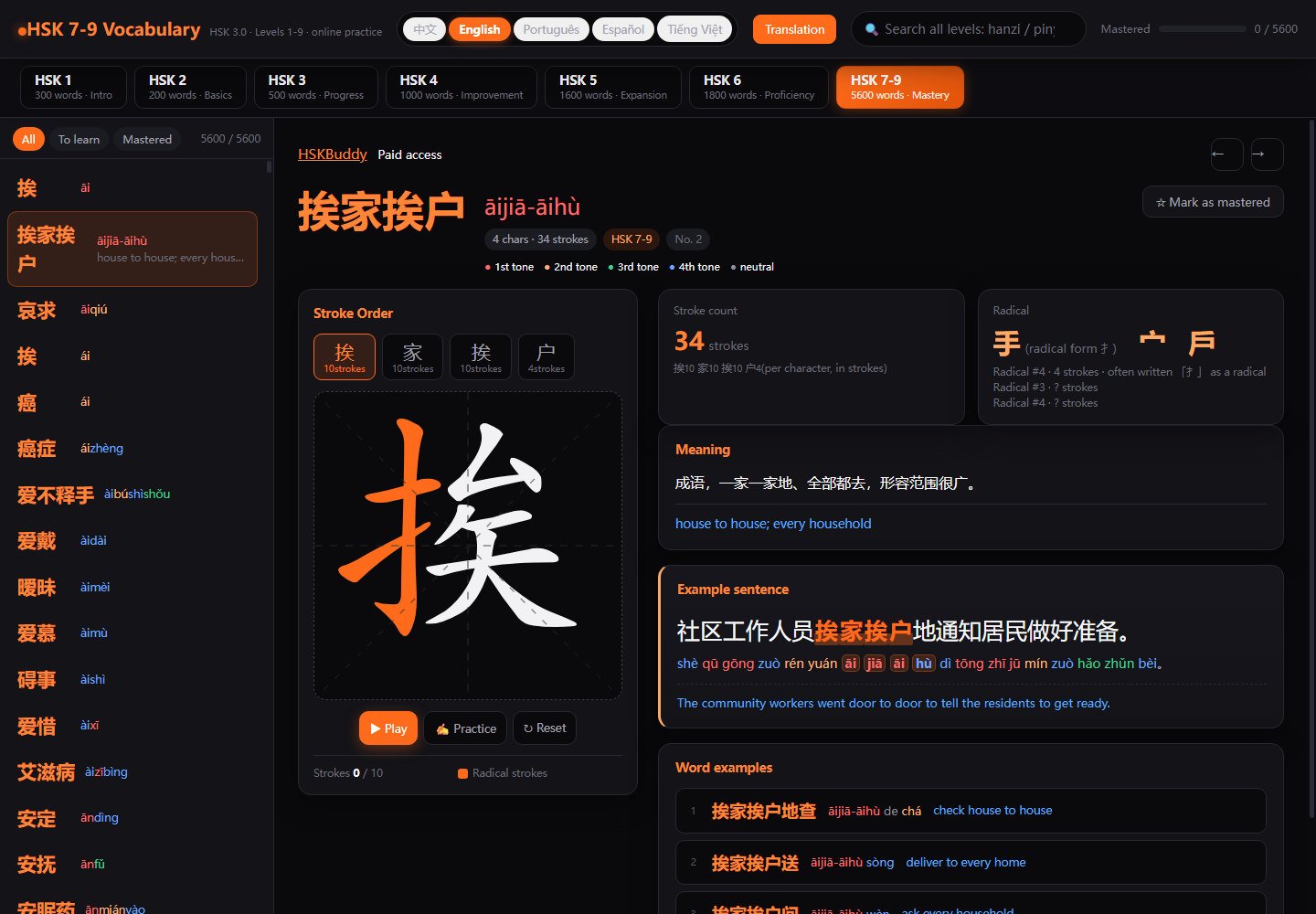
Explore words, pinyin, meanings, example sentences and character writing by level.

HSK CHINESE PRACTICE · 1–9
From your first Chinese words to more advanced sentences. Bring vocabulary, grammar and daily review together in one study space.
10 new words or questions a day after sign-up. Word lookup is always free.
LEARN WORDS IN CONTEXT
Connect a word with its pronunciation and the sentence around it. Choose a skill for today, then come back for a short review.
Explore words, pinyin, meanings, example sentences and character writing by level.
Check what you can recall, then revisit words that need another look.
Look up a structure and read examples before trying your own sentences.
Arrange words into sentences and notice where time expressions belong.
Notice the role a word plays in context, from nouns to verbs.
Compare related meanings and choose a word that fits.
Practise initials, finals and tones. Requires an active purchase.
Look up Chinese vocabulary whenever you need it. Always free.
A FREE MINI LESSON
Try this common pattern: subject + time + verb + object. Chinese can also place the time before the subject.
I study Chinese today.
In 我今天学汉语, 我 is the subject, 今天 tells us when, 学 is the verb and 汉语 is the object. The time expression goes before the verb. You can also say 今天我学汉语, placing the time first.
This public lesson is free and does not use your daily practice allowance.
| Chinese | Pinyin | Meaning |
|---|---|---|
| 今天 | jīntiān | today |
| 学习 | xuéxí | to study; to learn |
| 汉语 | Hànyǔ | the Chinese language |
Both 学 and 学习 can refer to learning or studying. 学 appears before 汉语 in our example. Read the whole sentence instead of translating one word at a time.
Put these words in order, with “tomorrow” before the verb.
我 · 汉语 · 明天 · 学我明天学汉语。 Wǒ míngtiān xué Hànyǔ. “I will study Chinese tomorrow.” 明天 means tomorrow and comes before 学. 明天我学汉语 is also possible.
Pick the level and one skill you are working on now.
Read a word with its pinyin and example, or study a sentence pattern.
Try recalling it, then revisit the items you found difficult.
Registered learners without a purchase can try 10 new words or questions per day across eligible tools. Reopening the same item that day does not count again. Resets at 00:00 UTC. Word lookup is always free. Pinyin pronunciation requires an active purchase.
Tools are organised into HSK 1, 2, 3, 4, 5, 6 and 7–9. Choose a level matching your study. HSKBuddy is an independent resource, not an official HSK exam provider.
Yes. The website offers English, Vietnamese, Portuguese and Spanish. Switch languages on the main website.
Listed options: US$9.99 for lifetime access to one selected HSK level, or US$4.99 per month for all levels while subscribed. Pinyin access follows the duration of an eligible purchase. See the main website for checkout availability and the terms for the scope of lifetime access.
No. Use it for reference and practice alongside teaching, reading, listening and conversations. No particular HSK score or exam result is guaranteed.
Choose your level. Find one thing to practise. Keep going at your own pace.
Explore the learning tools